Innovation Lab
Inventing the Wireless Architecture of 2030
From 6G concept research to AI-native network orchestration, our R&D investments today define the connectivity landscape of the next decade.
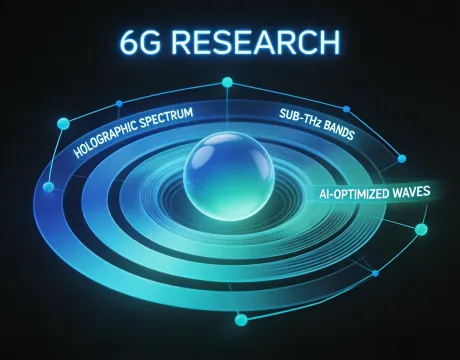
From 6G concept research to AI-native network orchestration, our R&D investments today define the connectivity landscape of the next decade.
Seven global laboratories working across the full wireless technology stack, from physical layer to application intelligence.
Experimental work on sub-terahertz bands (140-300 GHz) for ultra-wideband access. Our lab in Helsinki has achieved 1 Tbps aggregate throughput in controlled propagation environments using novel beamforming architectures.
Reinforcement learning models for real-time spectrum allocation, traffic engineering, and autonomous fault remediation. Deployed as a proof-of-concept across three operator networks managing 50,000+ base stations.
Programmable metasurface panels that dynamically shape radio propagation in indoor and urban canyon scenarios. Our 2,048-element prototype operates across 3.3-3.8 GHz with sub-millisecond reconfiguration time.
Dual-function waveforms that simultaneously carry data and perform radar-like environmental sensing. Applications include gesture recognition, occupancy detection, and non-contact vital sign monitoring.
Ambient energy harvesting techniques (RF backscatter, thermal gradient, vibration) enabling sensor nodes with theoretical infinite operational lifetimes. Current prototype achieves 200-meter range on harvested energy alone.
High-fidelity simulation environments that mirror live network topology, traffic patterns, and RF conditions. Used for risk-free testing of configuration changes, capacity upgrades, and disaster recovery scenarios.
Our multi-year investment strategy aligned with 3GPP release cycles and emerging market demand signals.
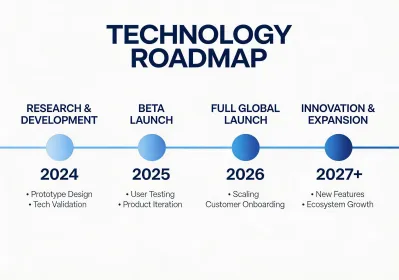
Network energy savings through AI-based sleep mode optimization, sidelink-based V2X for cooperative driving, and expanded RedCap for mid-tier IoT devices.
Sub-THz prototype deployments in controlled urban environments, RIS field trials with partner operators, and joint sensing-communication waveform standardization contributions.
Full autonomous network operations with closed-loop AI decision-making for spectrum management, energy optimization, and security threat mitigation.
Integrated sensing, communication, and computing fabric delivering Tbps-class access, sub-100 microsecond latency, and near-zero-energy endpoint connectivity.
Collaborative innovation with leading universities, standards bodies, and technology organizations worldwide.






Selecting the right wireless protocol depends on data rate requirements, power budget, range, and deployment density. No single protocol fits all use cases.
| Protocol | Data Rate | Range | Battery Life | Best Fit |
|---|---|---|---|---|
| NB-IoT (3GPP Rel-13+) | 250 kbps DL / 250 kbps UL | 10-15 km (rural) | 10+ years | Smart metering, asset tracking with carrier-grade reliability |
| LoRaWAN (Class A/C) | 0.3-50 kbps | 5-15 km (line of sight) | 5-10 years | Agricultural sensors, environmental monitoring, private deployments |
| LTE-M (Cat-M1) | 1 Mbps DL / 1 Mbps UL | 10+ km | 5-8 years | Fleet tracking, wearables, voice-capable IoT devices |
| 5G RedCap (Rel-17) | 150 Mbps DL / 50 Mbps UL | 1-5 km | 1-3 years | Video surveillance, industrial AR, mid-tier sensors |
| Wi-Fi 6E / 7 | 2-5 Gbps | 30-50 m (indoor) | N/A (powered) | Indoor enterprise, warehouse AGVs, high-throughput local |
Transparency about current limitations drives our research priorities. These are the technical boundaries we are actively working to overcome.
At 140 GHz, free-space path loss limits practical non-line-of-sight range to approximately 10-15 meters indoors without RIS assistance. Outdoor deployments above 100 GHz remain confined to short-range point-to-point links (<200m) until beam-tracking algorithms and antenna gain improve by an estimated 10-15 dB.
Current ambient RF energy harvesting yields 5-50 microwatts in typical indoor environments, sufficient only for intermittent sensing (temperature, humidity) at intervals of 30 seconds or longer. Continuous streaming or actuation applications remain beyond harvested energy budgets and still require battery or wired power.
While our reinforcement learning models demonstrate 15-20% efficiency gains in spectrum allocation, operator acceptance requires explainable decision rationale for each automated action. Current deep RL architectures lack the transparency needed for safety-critical decisions in carrier-grade environments, limiting autonomous operation to non-critical optimization tasks.
We partner with operators, enterprises, and research institutions to co-develop next-generation wireless technologies.
Explore Partnership Contact R&D