Industry Solutions

Wireless Innovation for Every Sector

Purpose-built connectivity solutions addressing the unique operational challenges of critical industries worldwide.

Smart Manufacturing

Smart Manufacturing

Private 5G and edge computing platforms purpose-built for Industry 4.0 environments where microsecond latency and deterministic connectivity drive production uptime.

  • AGV and AMR fleet coordination
  • Real-time machine vision quality control
  • Predictive maintenance sensor networks

Smart Cities

Smart Cities & Public Safety

LoRaWAN and cellular IoT infrastructure enabling municipalities to monitor, optimize, and automate urban services at metropolitan scale.

  • Intelligent traffic management
  • Environmental monitoring (air, noise, water)
  • Critical communications for first responders

Connected Transport

Connected Transport & Logistics

V2X communication modules and mobile edge computing for autonomous logistics, rail signaling, and port automation where split-second decisions save lives and revenue.

  • V2X / C-V2X communication modules
  • Fleet management IoT platforms
  • ETCS Level 3 rail signaling backhaul
Energy & Utilities

Energy & Utilities

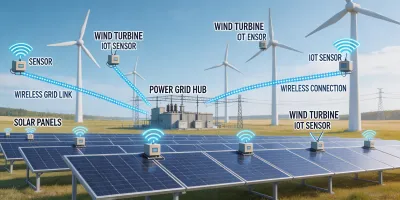
LPWAN sensor networks and private wireless solutions for remote asset monitoring, grid optimization, and predictive maintenance across distributed energy infrastructure.

  • Smart metering via NB-IoT
  • Substation monitoring & automation
  • Pipeline and transmission line surveillance

Healthcare

Healthcare & Life Sciences

Ultra-reliable low-latency wireless networks enabling remote patient monitoring, connected medical devices, and secure data transport within clinical environments.

  • In-building 5G for hospital campuses
  • Remote patient monitoring gateways
  • Medical device connectivity (BLE/Zigbee)

Mining & Resources

Mining & Natural Resources

Ruggedized wireless solutions for open-pit and underground operations where GPS-denied environments demand alternative positioning and communication architectures.

  • Underground LTE/5G mesh networks
  • Autonomous haul truck coordination
  • Personnel tracking & safety alerts

Deployment Impact

Measurable outcomes from real-world wireless infrastructure projects across multiple verticals.

34%

Production Throughput Increase

A German automotive tier-1 supplier (Baden-Württemberg region, 2023 deployment) achieved a 34% throughput increase after deploying a private 5G network on 3.7 GHz band for AGV coordination and inline quality inspection across a 12,000 m² assembly facility with 200+ connected endpoints.

< 3ms

End-to-End Latency

A container terminal operator in Rotterdam (2022 deployment, 1.2 km² coverage area) achieved sub-3ms round-trip latency for remote crane control using a dedicated 3.5 GHz small cell deployment across 28 quay cranes, replacing legacy Wi-Fi with 99.999% availability.

2.4M

Connected Endpoints

A Nordic electricity distributor (2021 rollout, serving 2.4 million residential meters) manages its smart metering infrastructure via NB-IoT network, achieving a 99.7% daily read success rate with projected 10-year battery life on field sensors—eliminating 85% of manual meter reading operations.

Connectivity Selection Considerations

Choosing the right wireless architecture involves balancing coverage, capacity, latency, and total cost of ownership. Two common trade-offs our customers evaluate:

5G mmWave vs. Sub-6 GHz Deployment

Millimeter wave (24-40 GHz) delivers massive bandwidth—up to 800 MHz channel widths—and ultra-low latency ideal for dense industrial environments like factory floors and ports. However, mmWave signals attenuate rapidly through walls and foliage, requiring small cell densities of 100-200 meters apart.

Sub-6 GHz bands (e.g., 3.5 GHz n78) offer wider coverage per cell site and better indoor penetration, making them more cost-effective for campus-wide and rural deployments. The trade-off: lower peak throughput (typically 1-2 Gbps vs. 10+ Gbps for mmWave) and higher per-user latency under load.

Selection factor: For localized high-density use cases (AGV fleets, remote crane control), mmWave delivers deterministic performance. For broad-area coverage (smart city IoT, logistics yards), sub-6 GHz provides better economics per square kilometer.

Fiber Optic vs. Enhanced Copper for Last-Mile Backhaul

Full fiber-to-the-premises (FTTP) provides future-proof bandwidth (10 Gbps+ symmetric), lower long-term maintenance costs, and superior latency characteristics for demanding applications like remote surgery or real-time video analytics.

Enhanced copper technologies (G.fast, VDSL2 vectoring) leverage existing twisted-pair infrastructure to deliver 500 Mbps-1 Gbps over short distances (<250m), enabling faster rollout at 30-50% lower upfront cost compared to new fiber trenching.

Selection factor: New greenfield deployments strongly favor fiber for 15+ year lifecycle economics. Brownfield upgrades with existing copper plant may benefit from hybrid approaches where G.fast serves as an interim solution before full fiber migration.

Explore What Wireless Can Do for Your Industry

Our solutions architects specialize in translating operational challenges into measurable connectivity outcomes.

Schedule an Industry Consultation